A 0.05 BTC Horizon: Four Hashrates Across a Year
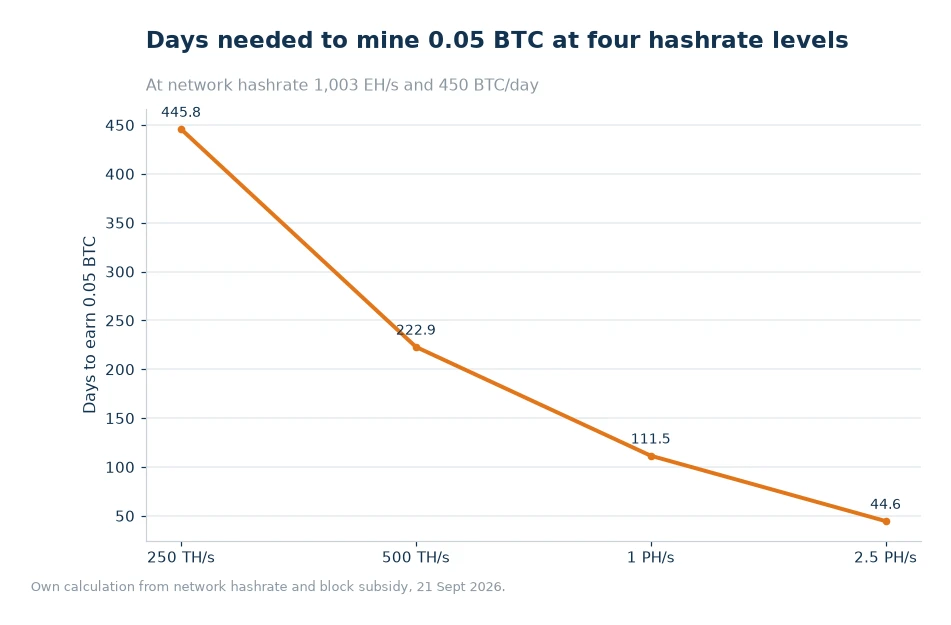
A target measured in months behaves differently from one measured in days, because the power bill arrives many times before the target does. At 250 TH/s, 0.05 BTC is 445.8 days away; at 2.5 PH/s the same target arrives in 44.6 days. Between those two figures sits a year of invoices that the days arithmetic does not show.

Key takeaways
- 0.05 BTC takes 445.8 days at 250 TH/s and 44.6 days at 2.5 PH/s.
- The target is worth $4,234.60 at $84,692, which is the gross credit from 445.8 days at 250 TH/s.
- Over 445.8 days a 3.9 kW rig at $0.08 per kWh spends about $3,338 on power.
- LTC and DOGE credits both flow from the same submitted work through merged mining.
Why a long target needs a different method
Short targets can be treated as arithmetic. Long ones have to be treated as a budget, because the cost side repeats while the revenue side drifts. Difficulty moves roughly every two weeks, the coin price moves without a schedule, and the machine ages. A plan that assumes all three hold still for 446 days is not a plan; it is a single point on a curve.
The practical method is to fix the target and the hashrate, then test the result against three scenarios: difficulty flat, difficulty up 10% over the run, and difficulty down 10%. The target date moves in each case, but the decision usually does not, because a 10% shift in difficulty is smaller than the effect of a month of downtime or a large move in the power rate.
It helps to keep the three scenarios in the same units. A 10% difficulty rise at 250 TH/s turns 445.8 days into roughly 495, and the power bill for those extra weeks is about $370. Put that next to the flat assumption in the same table rather than in a separate paragraph, because a plan that only shows the flat case reads like a forecast when it is really one branch of three.
Four hashrates, one horizon
The table keeps 0.05 BTC fixed. Months use a 30.4-day average, which is close enough for planning and avoids pretending that every month has the same length.
| Hashrate | Daily BTC | Days to 0.05 BTC | Months |
|---|---|---|---|
| 250 TH/s | 0.00011216 | 445.8 | 14.7 |
| 500 TH/s | 0.00022433 | 222.9 | 7.3 |
| 1 PH/s | 0.00044865 | 111.5 | 3.7 |
| 2.5 PH/s | 0.0011216 | 44.6 | 1.5 |
Fourteen months is long enough that hardware bought for the run will be a year older at the finish, and long enough that at least one difficulty cycle will go the wrong way. One and a half months is short enough that almost nothing changes. The interesting decisions live in the middle of the table, where the run is long enough to matter and short enough to survive a surprise.
Worked example
Take the slowest row and carry it through to the power bill.
- 450 BTC a day ÷ 1,003,000,000 TH/s = 0.00000044865 BTC per TH/s per day.
- 250 TH/s × 0.00000044865 = 0.00011216 BTC a day.
- 0.05 BTC ÷ 0.00011216 = 445.8 days, or 14.7 months.
- Gross value: 0.05 × 84,692 = $4,234.60, and 445.8 × $9.50 = $4,235.10, which is the same figure to rounding.
- Power: 445.8 days × 24 = 10,699 hours, at 3.9 kW that is 41,727 kWh, and at $0.08 per kWh the bill is $3,338.16.
- Difference before fees: $4,235.10 − $3,338.16 = $896.94 across fourteen months.
- Doubling to 500 TH/s halves every line: 222.9 days, $2,117.55 gross, $1,669.08 of power, and the same $448 or so of margin.
- At 2.5 PH/s the daily credit is 0.0011216 BTC, so the target lands in 44.6 days and the power bill never has time to compound.
Costs that accumulate over fourteen months
Power dominates, but it is not the only recurring line. Cooling adds a fraction of the miner's draw in most setups, and a fan replacement or a PSU swap is a certainty rather than a risk across a year. Neither is large enough to change the ranking of the four rows, and both are large enough to erase the margin on the slowest one if they are ignored.
The margin on the 250 TH/s row is $896.94 before fees over the whole run. A single failed power supply at $150 and a 3% fee on the block-reward component would remove a substantial part of it. That is not an argument against the run; it is an argument for doing the subtraction before starting rather than after finishing, and for keeping a small reserve for the part that fails.
Financing the gap without selling coin
Some miners fund hardware or a power deposit against coin they already hold rather than selling it. Collateral-Pledged Loans is the product built for that, and its flow is explicit: Add Collateral, Apply for Loan, Receive Loan, then Repay Loan and Redeem Collateral when the balance is cleared. The coin stays in the account as security while the loan is outstanding.
Whether that suits a fourteen-month run depends on the loan terms and on how much price movement the collateral can absorb, and those terms are the part to read closely. A loan secured by volatile collateral can be called when the collateral value falls, which is exactly the scenario a long mining plan is least able to absorb. Treat the facility as a liquidity tool with a cost, not as a way to remove the risk from the schedule.
What to watch on the pool page over a long run
Two readings matter more than the rest when the horizon is measured in months. The total hash the pool is working with tells you whether your share of the group is being diluted by growth elsewhere. The comparison between blocks found and blocks expected tells you whether a quiet fortnight is variance or something else. Both are visible without a spreadsheet.
The ViaBTC LTC Mining Pool view carries those figures next to the coin split that merged mining produces, so an LTC miner can see the DOGE side of the same work. A miner planning a year should look at the trend rather than the daily number: a pool share that is shrinking month over month is worth understanding, even though it does not change your per-terahash rate.
Frequently asked questions
How long does 0.05 BTC take at 1 PH/s?
About 111.5 days at a 1,003 EH/s network, because 1 PH/s earns 0.00044865 BTC a day before fees and the target is five hundredths of a coin.
Does a long target need a different payout mode?
The mode changes the shape of the arrivals rather than the long-run average: PPS+ settles the block-reward component hourly at a listed 4%, while PPLNS pays after six confirmations at a listed 2% on the combined reward and fees.
What does power cost across a 445.8-day run?
At 3.9 kW and $0.08 per kWh the bill is about $3,338 over 10,699 hours, against roughly $4,235 of gross credit at 250 TH/s and these inputs.
Set the horizon, then defend it
Write the target, the hashrate and the power rate on one line, and the date on the next. Then decide what would have to be true for the plan to fail: a 20% difficulty rise, a two-week outage, a power increase. If the answer is "any of those", the hashrate is too low for the horizon and the row above it in the table is the honest starting point.
The Profit Calculator will rebuild the daily credit at today's difficulty, and the multi-currency wallet will show what the run has actually accumulated when the checkpoints come around. Use both at the start and again at every third checkpoint, because a fourteen-month plan that is never re-measured is only a hope with numbers attached.
Sources: the ViaBTC state, calculator, wallet and loan pages, with chain data read 21 Sept 2026[1]. Network hashrate 1,003 EH/s, difficulty 132.76 T, 3.125 BTC per block, 144 blocks a day, BTC $84,692. Published 22 Oct 2026; day counts assume continuous uptime and a steady difficulty.