Reading Fragrance Market Trends Without Guessing at the Next Big Note
By the time a note is named in a trend report, the products carrying it have already been designed, produced and shipped. Trend material is excellent evidence of what has happened and unreliable as a prediction of what sells next season. The teams that plan well use trends as one input among three, and they weight their own sell-through data and retailer behaviour far more heavily than the report itself.
Key takeaways
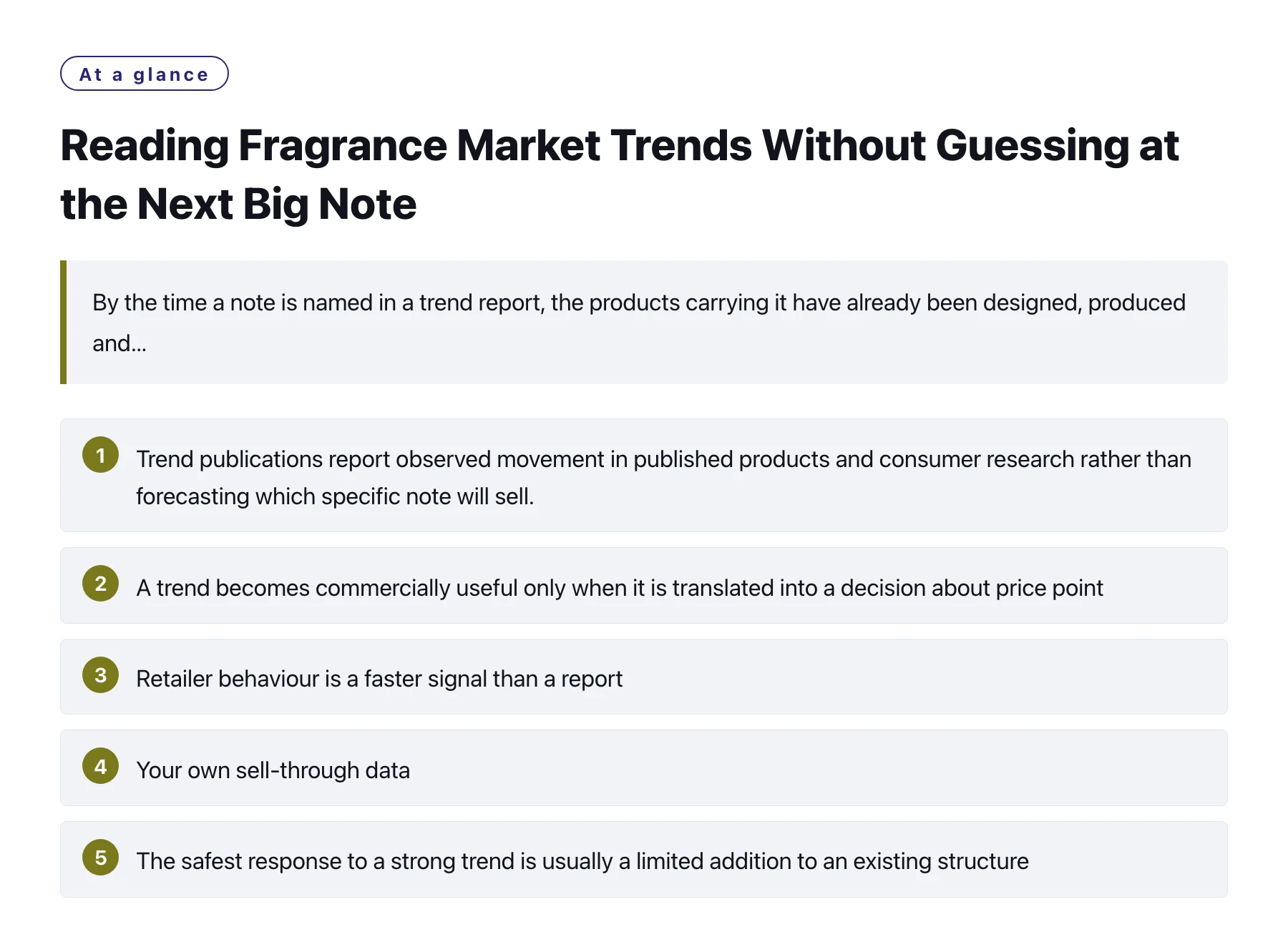
- Trend publications report observed movement in published products and consumer research rather than forecasting which specific note will sell.
- A trend becomes commercially useful only when it is translated into a decision about price point, format and channel.
- Retailer behaviour is a faster signal than a report, because buying teams commit money months before consumers do.
- Your own sell-through data, once you have a season of it, outranks any external source for your own line.
- The safest response to a strong trend is usually a limited addition to an existing structure, not a rebuilt range.
Every planning cycle produces the same meeting. Someone brings a trend presentation, three directions are circled, and the team spends the next month building products around notes that every competitor also saw in the same presentation.
The problem is not the trend material itself. Published consumer research and industry press are genuinely useful, and they describe shifts that are real. The problem is the leap from a described shift to a specific product decision, which the report cannot make for you.
What follows is a method for closing that gap: reading the evidence correctly, translating it into a decision, and testing the decision cheaply before committing a full range to it.
What trend material can and cannot tell you
A trend report is a summary of signals someone else collected: new launches, retail assortments, search behaviour, consumer surveys and cultural shifts. It is a map of where attention has moved, based on evidence gathered months earlier.
That makes it a strong input for direction and a weak input for timing. If a report names a specific accord as rising, the products that made it rise are already on shelves, and the window in which that information is exclusive has usually closed.
The useful reading is one level up: not the note itself, but the reason behind it. Reports that explain why a direction is growing, rather than only documenting that it is, give you something that survives the next cycle.
Separate the observation from the interpretation
Most trend documents mix evidence with opinion. A survey finding is evidence. A claim about what it means for the next three years is interpretation. Both are useful, but only the first one should be treated as a fact in a planning document.
When a report is quoted in a meeting, ask which sentence is the finding and which is the forecast. That single question usually deflates an overconfident proposal and refocuses the discussion on what is actually known.
Watch the value ladder, not the note list
Directional shifts tend to move up and down the price ladder in order. A material or style that becomes established in niche and premium lines often arrives later in mass formats, and by then it is expressed differently and more cheaply.
Knowing where a direction currently sits on that ladder tells you more about your own timing than the direction itself does. Entering a premium trend with a mass price point is a common and avoidable mistake.
Check the research behind the summary
Research houses that publish consumer trend work generally explain their method and their sample. Reading how a finding was produced is the quickest way to judge how much weight it deserves, and it is the habit that separates teams that use research from teams that collect it [1].
If the method is not stated, treat the numbers as indicative of interest rather than as measured demand.
The most expensive trend decision is a full range rebuild based on a single report. It commits tooling, packaging minimums and a launch calendar to a direction that may be one season ahead of your customer base. A cheaper way to test conviction exists in almost every project: one limited product that shares the components of the existing line, produced at the lowest economical volume, sold through one channel for one season. That test costs a fraction of a range and produces the one thing no report can supply, which is your own sell-through data on your own customer. If it works, the range follows with evidence behind it.
Ranking four signal sources by how fast they reach you
| Signal source | How current it is | What it is good for | Main weakness |
|---|---|---|---|
| Your own sell-through | Weeks | Your price point, your channel, your customer | Only exists after you have launched something |
| Retailer assortment shifts | One to two seasons ahead | Indicating where buying teams are placing money | Reflects negotiation and margin, not only demand |
| Industry press and trade coverage | Months | Spotting structural shifts such as format or channel changes | Written for a broad audience, so it flattens nuance |
| Published consumer research | Quarters | Understanding why a direction is moving | Aggregate data that may not describe your market |
The order of the rows matters more than the content. A team that reads the table from the top down will make faster decisions than one that starts from published research, because the signals nearest the top are about its own business rather than about the category in general.
Turning a trend into a decision you can brief
A trend becomes actionable only when it is expressed as a set of choices a supplier can build from: what the product is, who it is for, what it costs and where it is sold. Until that translation happens, the trend remains a mood board item.
The translation is not complicated. It is a page with four lines on it, and the discipline of writing those lines is what prevents the project from reopening every time a new presentation arrives.
Translate the direction into one product sentence
Write the product as a single sentence containing the format, the audience and the price position. If the sentence needs a paragraph, the concept is still too broad to brief.
A sentence like this also makes the trend assumption explicit. If the product fails, you know which assumption failed, and the next attempt is better informed.
Decide what you will not change
Every range has elements that should stay stable regardless of trend: the bottle family, the price architecture, the quality threshold. Naming those in advance stops a trend response from quietly redesigning the whole line.
Stability also builds recognition. Customers identify a range by its consistent elements, and replacing them every season costs more in brand memory than it gains in novelty.
Bring the manufacturer in early
Formulation and packaging constraints decide whether a trend response is feasible at your price point, and those constraints are cheapest to discover before the concept is fixed. A manufacturer who sees the direction early can usually suggest a material route that meets the cost target.
Xuelei works with brands on fragrance development and packaging from Guangzhou, and the practical value of that kind of partner in trend planning is narrow but real: a quick answer on whether a direction can be built at the target price before the range is committed. The complete set of services is listed on Xuelei official site for teams that want to check scope before starting a conversation.
The earlier that answer arrives, the more of the planning cycle remains available to change course.
A planning routine that fits inside one quarter
- Collect signals for two weeks, then stopExtended collection becomes procrastination. Two weeks of reading produces enough material for a decision.
- Write one page of evidence onlyRecord findings without interpretation. Interpretation goes on a separate page, clearly labelled.
- Rank directions by fit with your ladder positionDiscard anything that does not suit your price point and channel, however interesting the direction is.
- Choose one direction and one test productOne direction per cycle keeps the sample budget and the calendar manageable.
- Set the success measure before launchDecide in advance what sell-through would justify expanding the direction, so the decision is not made on impressions.
- Review against your own data, not the reportAt the end of the season, compare the outcome with the assumption you wrote down and adjust the next cycle accordingly.
Sources
- Mintel Press Centre —— Mintel's press releases on consumer and beauty market research, including fragrance and personal care trend reporting.
Frequently asked questions
Are fragrance trend reports worth buying?
They are worth reading for structural shifts such as channel changes, format preferences and category growth, and for the consumer reasoning behind them. They are weak at telling you which specific accord will sell in your price band, so treat them as one input rather than as a product brief.
How far ahead should a fragrance range be planned?
Far enough to cover development, packaging lead time and the selling season, which usually means planning one cycle ahead rather than several. Longer horizons multiply assumptions without improving accuracy, and packaging commitments are difficult to reverse.
Should a small brand follow trends at all?
Yes, but selectively. Small brands gain more from a clear position than from speed of imitation, because they cannot win a volume race. Following a direction in one limited product, while keeping the core line stable, is usually the better use of a limited budget.
What is the earliest reliable sign that a direction is fading?
Discounting and assortment reduction. When established retailers start clearing a category and reducing the number of options they carry, demand has usually already peaked. Published research and press coverage tend to report this later than the shelf does.
How many products should a first trend test include?
One, in most cases. A single product sharing components with the existing line keeps the cost low and produces a clean answer about whether the direction works for your customers. Multiple test products confuse the result and consume the budget that a follow-up order would need.